What a bathroom subfloor repair costs in Sydney
A bathroom subfloor repair in Sydney generally costs between $2,500 and $12,000. A contained repair where one section of sheeting and a single bearer have been affected by a slow leak usually lands near the bottom of that range, while a full rebuild that involves new bearers, new joists, new sheeting, a fresh screed and new waterproofing sits at the top.
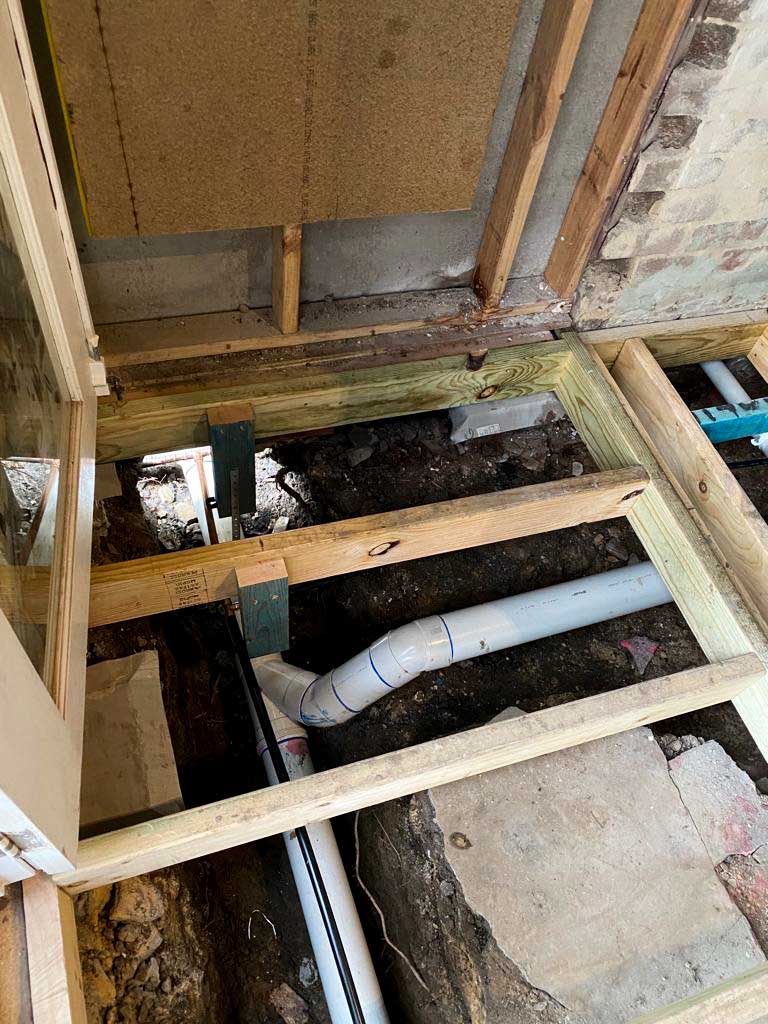
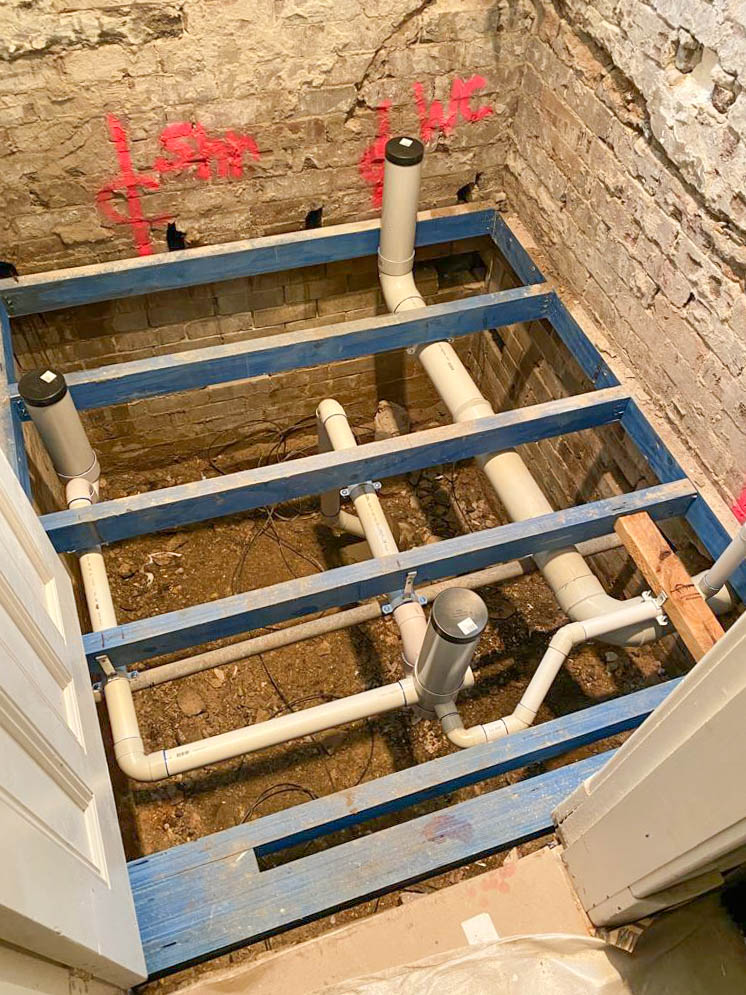
The job photographed on this page, in an older home in Ashbury, came to approximately $6,500 including removal of the damaged material, new plumbing and a completely rebuilt floor structure.
Nu-Trend is a licensed plumbing and bathroom renovation company that has worked in Sydney since 2009. Because we hold both the plumbing licence and the renovation licence, we can trace the leak, open the floor, rebuild the structure and finish the bathroom without handing the job between three separate trades, which is where most of the delay and most of the finger pointing on this type of repair comes from.
What a subfloor repair costs, by the size of the problem
The single most useful thing to understand about this work is that the price is driven by how far the water travelled before anyone noticed, not by the size of the bathroom. Two rooms of identical size can be thousands of dollars apart because one was caught in the first year and the other was left for a decade.
| What has failed | Typical scope | Indicative cost |
|---|---|---|
| What has failedOne section of sheeting under a leaking shower | Typical scopeCut out and replace the affected sheeting, re-screed and re-waterproof the section, re-tile the area | Indicative cost$2,500 to $4,500 |
| What has failedSheeting plus one or two bearers or joists | Typical scopeProp the floor, replace the affected structural timbers, new sheeting, screed and waterproofing across the room | Indicative cost$4,500 to $8,000 |
| What has failedFull structural rebuild of the floor | Typical scopeRemove the entire floor, replace all bearers and joists, new sheeting, new plumbing where required, full screed and waterproofing | Indicative cost$8,000 to $12,000 |
| What has failedConcrete slab with rusting reinforcement | Typical scopeSaw cut the affected slab, remove the failed concrete, install new reinforcement and repair the slab before renovating over it | Indicative cost$3,500 to $7,000 |
Prices are indicative ranges based on completed Nu-Trend jobs in Sydney and are confirmed only after the floor has been opened up and the extent of the damage is visible.
These figures cover the repair of the floor itself. If the bathroom is being renovated at the same time, which is what happens on most of the jobs we quote, the floor repair becomes one line inside a larger scope and the cost of tiling, fixtures and fit off sits on top.
Our guide to bathroom renovation costs in Sydney sets out what a complete room comes to, and the fourth row above refers to a renovation in Penshurst where we repaired concrete cancer under the floor.
A real job: repairing a water damaged subfloor in Ashbury
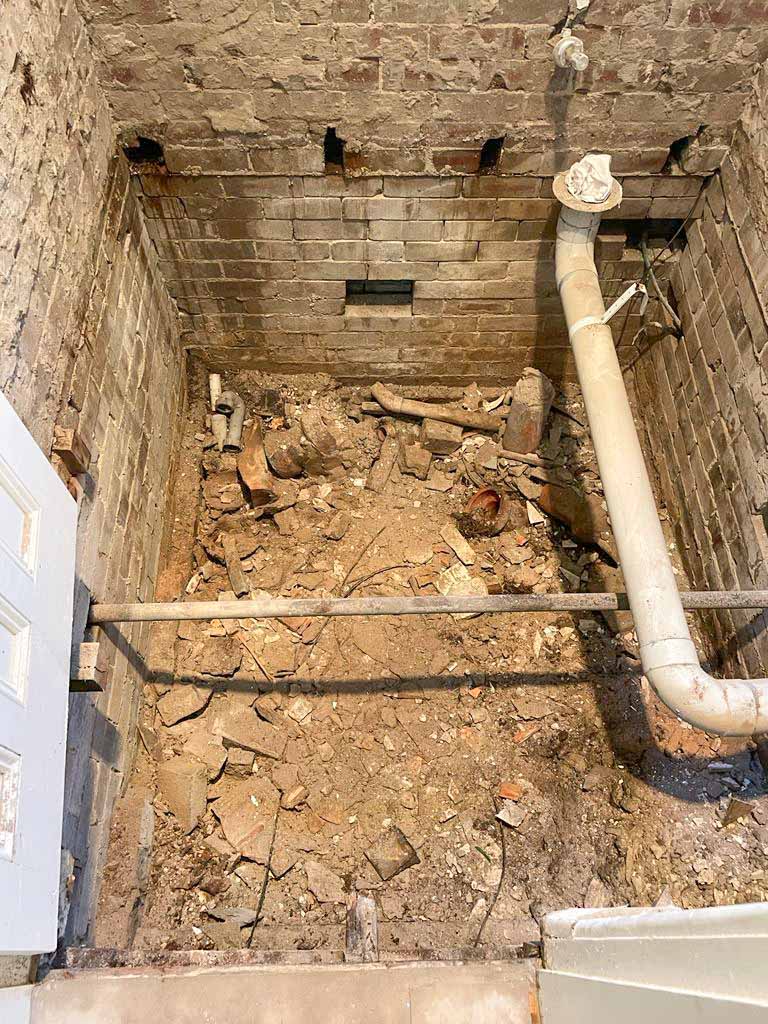
The photographs on this page come from a home in Ashbury built in the 1940’s where the owners called us about tiles that had begun to crack near the shower. When we lifted the floor we found that the waterproofing membrane had failed at the junction between the shower base and the wall, and that water had been running into the floor structure for long enough to rot the sheeting and soften two of the bearers underneath.
The repair took approximately 4 days and required us to remove all of the damaged material, replace the plumbing that ran through the affected area, install new bearers and joists, and rebuild the subfloor so that the new bathroom could be laid over a sound structure.
The total for that structural work was approximately $6,500. The owners had been quoted for a cosmetic re-tile by another company several months earlier, which would have covered the problem without addressing it and would have failed again within a year or two.
The owners were originally shocked but also very understanding about the information that we were giving them. Of course they were not happy having to pay for a variation but they also understood it wasn’t our fault and that it was a preventative measure.
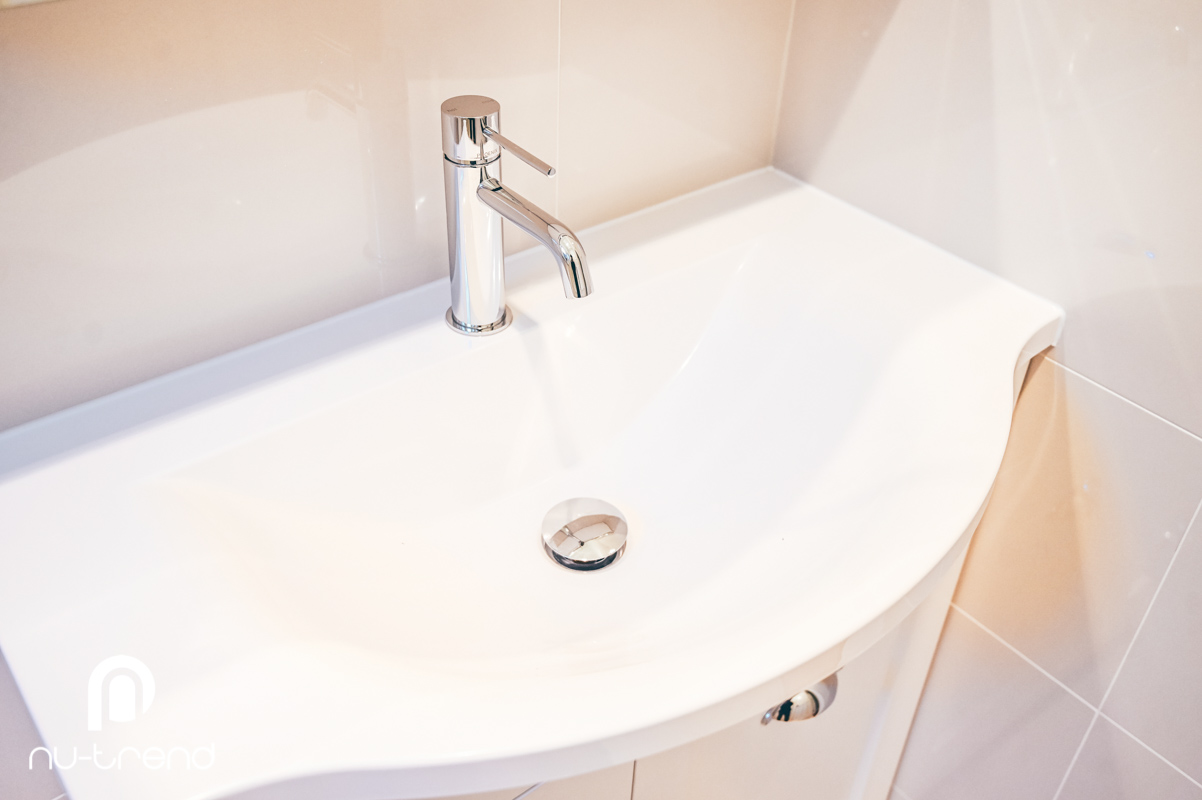
Bathroom renovation in an old home in Ashbury
We renovate bathrooms in old homes. See our complete bathroom renovation in Ashbury that also required sub floor repair work
How to tell whether your bathroom subfloor has failed
Most homeowners come to us after noticing one of these six things. Any one of them on its own is worth investigating, and two or more occurring together usually means the structure below the tiles has already been affected.
The floor feels uneven or sunken in one area
A soft or low spot means the sheeting below the tiles has lost strength. Catching it while it is confined to one area is what keeps the repair in the lower cost band, because rot spreads through timber steadily once it has started.
The floor moves or bounces when you walk on it
A floor that feels springy underfoot indicates that either the sheeting or the structural timbers beneath it are no longer carrying load properly. In a bathroom this is almost always moisture rather than age.
The room smells musty even after it has been aired out
The smell of mould or mildew that persists when the room is dry is a reliable sign of water sitting somewhere it should not be. The difficulty is that the source is rarely where the smell is strongest, which is why a plumber with a leak detection background is worth involving early.
The toilet rocks or the fixings have gone loose
When the material around the toilet fixings decays there is nothing left for the fasteners to grip. This is frequently the first visible symptom of a slow leak at the pan connector, and it is often dismissed as a loose bolt for years before anyone lifts the floor.
Floor tiles have started to crack, particularly in a line
Tiles are rigid and require a solid, stable base. Cracking that follows a line across the room generally indicates movement in the sheeting or in a joist beneath it rather than a problem with the tile or the adhesive.
Grout is lifting or the silicone at the floor junction keeps failing
Repeated failure of grout and silicone in the same place suggests continuing movement. Replacing the silicone treats the symptom, and the movement underneath will keep breaking whatever you put there.
What a damaged subfloor looks like once the tiles come up
The visible signs before demolition are limited to what the surface will tell you, which is why an inspection that includes lifting a tile or accessing the space beneath the floor gives a far more reliable answer than a visual assessment from inside the room.
Once the floor is opened, damage typically presents as darkened and flaking sheeting, timber that can be pressed in with a thumb, visible mould growth on the underside of the floor, corrosion on any metal fixings, and water staining that spreads outward from the shower or from the base of the toilet.
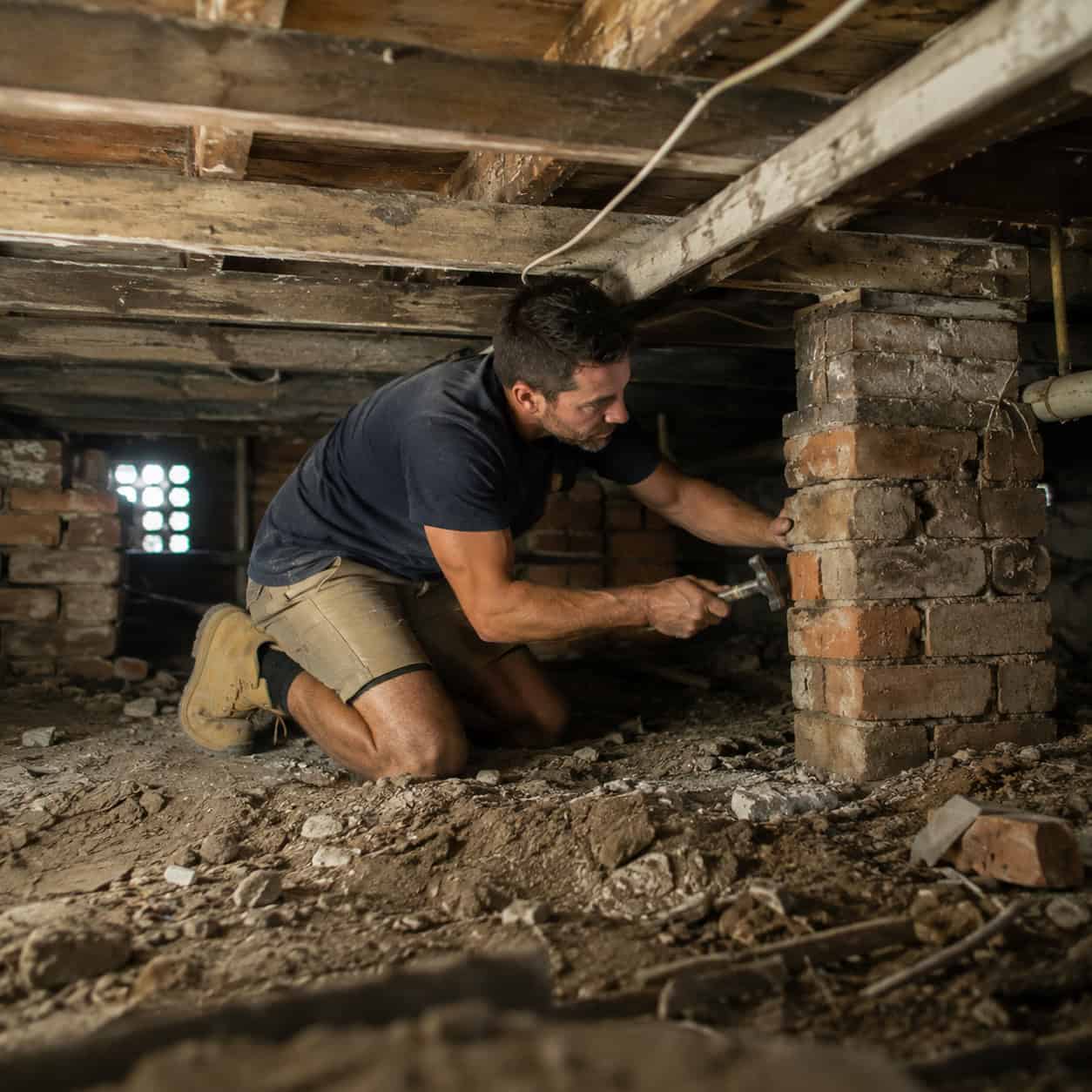
In homes with a suspended timber floor it is often possible for us to inspect from underneath through a subfloor access point, which tells us how far the damage has travelled without removing a single tile. That inspection is the difference between quoting a range and quoting a price. The other common cause of a failed bathroom floor is the wrong substrate, which is why floor preparation matters as much as the plumbing does.
What does it cost to replace the floor joists under a bathroom?
Replacing floor joists under a bathroom typically adds between $1,500 and $4,000 to a subfloor repair in Sydney, depending on how many members are affected, whether the bearers below them also need replacing, and how much access there is beneath the house. This is structural work rather than surface work, so the floor above has to be propped while the affected timbers are removed and new members are installed and levelled.
Joists are affected less often than the sheeting above them, because the sheeting takes the water first and can absorb a great deal of it before anything reaches the structure.
When joists have gone it usually means the leak has been running for years. In a Federation or interwar home in the inner west, where the original floor structure is now eighty to a hundred and twenty years old, we also frequently find that timbers which are technically sound are undersized by current standards, and rebuilding to modern spacing is a sensible use of the access that the repair has already created.
We don’t normally upgrade joist spacing, we tend to strengthen the joists if we can because upgrading the spacing is major renovation work & outside the scope of a normal renovation.
The eight things that move the price
Every bathroom has to be built to the National Construction Code and to the Australian Standards that sit under it, including AS 3740 for waterproofing of domestic wet areas and AS/NZS 3500 for plumbing and drainage. Those requirements set the floor for what any compliant repair must include. Within that, the following factors are what actually separate a $2,500 job from a $12,000 one.
- How far the water travelled. This is the largest single variable and it is the reason that acting early saves thousands rather than hundreds.
- Whether the structure is affected or only the sheeting. Once bearers and joists are involved the work becomes structural and the floor has to be propped.
- Floor construction. A suspended timber floor on piers, which is what most pre-war homes in the inner west have, is generally more straightforward to repair than a concrete slab where reinforcement has begun to rust.
- Access. A ground floor bathroom with a crawl space beneath it is considerably easier to work in than a first floor bathroom in a terrace where every piece of material has to be carried through the house.
- What the floor is carrying. A freestanding bath full of water, a stone topped vanity or a tiled hob all place load on the floor and influence how the structure has to be rebuilt.
- Plumbing that has to be replaced or relocated while the floor is open. This is often the most sensible moment to do it and it does add to the cost of the repair itself.
- Waterproofing and screed. A compliant repair includes a new membrane and a new screed over the repaired area, certified and documented.
- Disposal and protection. Removing the old material and protecting the path through the house are real costs that some quotes leave out and then add later.
How long the work takes and what happens to the rest of the house
A contained section repair usually takes 6-10 days on site, plus drying time for the screed and the waterproofing membrane before tiling can begin (this can vary depending on the product/s we use as some allow for faster curing times. Weather can also impact curing time).
A full structural rebuild of a bathroom floor typically runs to 10 to 20 days days of structural work depending on the scope & if it is timber or concrete joists we are working with. Again, followed by the drying periods that the membrane manufacturer specifies. Those drying periods are not padding and they cannot be compressed. A membrane that is tiled over before it has cured is the reason a proportion of the failures we are called to inspect exist at all.
While the floor is open the bathroom is out of use, so on a single bathroom home we discuss access arrangements before the job starts. We cover the path from the entry to the bathroom, we remove demolition material rather than leaving it in the yard or on the street, and we clean at the end of each day.
Will home insurance cover a rotten bathroom subfloor?
Home insurance policies in Australia commonly cover damage caused by a sudden escape of water, such as a pipe that bursts, and commonly exclude damage that has occurred gradually through a slow leak, deterioration or lack of maintenance. Because most bathroom subfloor damage is the result of a membrane or a joint that has been failing for years, it frequently falls into the excluded category rather for insurance policies relating to water damage in Australia.
This is worth checking rather than assuming, and it is worth checking before the floor is repaired rather than afterwards, because an insurer will generally want to inspect or at least see photographs of the damage in place. We document what we find with photographs on every job for exactly this reason, and we are happy to provide them.
Who should you actually call for this work?
Several trades can legitimately be involved in a bathroom subfloor repair, and understanding what each one does makes it easier to decide who should lead the job.
| Trade | What they bring | Where the limit is |
|---|---|---|
| TradeLicensed plumber | What they bringFinds and fixes the leak that caused the damage and certifies the drainage work | Where the limit isWill not usually rebuild the floor structure or finish the room |
| TradeLicensed builder or renovator | What they bringRebuilds the floor structure and finishes the bathroom | Where the limit isCannot legally carry out the plumbing work without a plumbing licence |
| TradeWaterproofing specialist | What they bringInstalls and certifies the new membrane | Where the limit isAttends one stage only, so cannot own the whole job |
| TradeStructural engineer | What they bringDesigns a solution where the damage extends beyond the bathroom | Where the limit isRequired only on the minority of jobs where the structure is significantly compromised |
Nu-Trend holds both a plumbing licence and a building licence, which is why one contract covers the leak, the structural repair and the waterproofing rather than three separate trades handing the job between them.
On most bathroom subfloor repairs the practical answer is a company that holds both the plumbing licence and the renovation licence, because the leak, the structure and the finished room are then the responsibility of one business rather than three.
Nu-Trend holds NSW contractor licence 217859C covering plumbing, drainage, gasfitting and kitchen, bathroom and laundry renovation, we carry twenty million dollars in public liability cover, and both directors work on site.
Where a job genuinely requires a structural engineer we will tell you and we will work alongside one.
Common questions about bathroom subfloor repairs
Can you repair a bathroom subfloor without removing all the tiles?
Sometimes, where the damage is confined to a small area and the tiles can be lifted cleanly, although matching existing tiles is usually the limiting factor rather than the structural work. In most cases the tiles were laid over the original screed and cannot be recovered intact, so the practical choice becomes a partial repair with a visible patch or a repair combined with a re-tile of the room.
How do I know whether it is the waterproofing or the plumbing that has failed?
A leak that appears only when the shower is running usually points to the waterproofing membrane or a shower base junction. A leak that continues regardless of whether anyone is using the room usually points to a pressurised water pipe. Damage concentrated at the base of the toilet generally points to the pan connector. An inspection that includes pressure testing distinguishes between them reliably, and guessing between them is how people end up paying twice. We cover why bathrooms get water leaks in Sydney separately.
Is it worth repairing the floor if the bathroom is old anyway?
If the bathroom is more than twenty years old and the floor has to come up, the cost of doing the structural work in isolation and then renovating the room in a few years is substantially higher than doing both at once, because the demolition, the waterproofing and the screed all have to be done twice. Where the bathroom is recent and the damage is contained, a repair on its own is the sensible choice.
What happens if a damaged subfloor is left alone?
Rot in timber does not stabilise. It spreads along the affected member and into adjoining timbers, and because the space beneath a bathroom floor is dark, warm and damp it also supports mould growth. The repair that would have cost $3,000 in the first year becomes a full structural rebuild, and in the worst cases the damage extends past the bathroom into adjoining rooms.
Do you work in the inner west?
Yes. We work across Sydney and a significant share of this particular type of job comes from the inner west and the inner south, including Ashbury, Ashfield, Summer Hill, Dulwich Hill, Marrickville, Petersham and Stanmore, where Federation and interwar homes with suspended timber floors are common and where bathrooms were frequently renovated in the nineteen eighties and nineties over floors that were never properly waterproofed.
Get the floor looked at before it gets more expensive
If your floor is moving, your tiles are cracking or your bathroom smells musty, the most useful next step is a bathroom inspection rather than a quote, because until someone has looked under the floor any price is a guess.
We will come out, assess what has actually happened and give you a written scope with a fixed price.
Call Rick on 0401 165 779 or request a site visit and we will arrange a time that suits, including outside normal working hours.