Adding a toilet to your existing plumbing in Sydney
Adding a second toilet to an existing home in Sydney typically costs between $2000 and $12,000, depending on how far the new fixture sits from the existing sewer connection, whether the floor has to be opened, and whether the room around it also needs building work. In most homes it is entirely possible, and the deciding factor is rarely the toilet itself but the drainage that has to reach it.
Nu-Trend is a licensed plumbing and bathroom renovation company that has worked in Sydney since 2009. Because we hold NSW contractor licence 217859C covering plumbing, drainage and renovation, we can assess the drainage, do the work, complete the compliance paperwork and finish the room. That matters on this particular job type, because adding a new fixture triggers requirements that a like for like bathroom renovation does not.
What it costs to add a toilet to an existing home
The cost is driven almost entirely by the distance and the fall between the new toilet and the existing sewer line, and by how much of the building has to be opened to get there. The toilet suite itself is a minor part of the total.
| Scenario | What is involved | Indicative cost |
|---|---|---|
| ScenarioNew toilet close to the existing stack, ground floor | What is involvedCut into the existing drainage line, run new waste and vent, connect water supply, install and commission | Indicative cost$2,000 to $5,000 |
| ScenarioNew toilet in a converted laundry or under stairs | What is involvedAs above plus floor work, waterproofing where required, and building work to form the room | Indicative cost$15,000 to $30,000 |
| ScenarioNew toilet on an upper floor | What is involvedNew drainage run through the building fabric, additional venting, more making good | Indicative cost$8,000 to $16,000 |
| ScenarioMacerator where gravity drainage cannot reach | What is involvedInstall macerator unit, small bore discharge line, power supply and connection | Indicative cost$5,000 to $12,000 |
Prices are indicative ranges based on completed Nu-Trend jobs in Sydney. The final figure depends on how far the new toilet sits from the existing drainage line and what has to be opened up to reach it.
These are ranges for the plumbing and installation work. If the toilet is going into a room that also needs tiling, a basin, a door or ventilation, those items sit on top and are quoted separately. We give a fixed written price after a site visit rather than an estimate over the phone, because on this job the variable that decides the price is underneath the floor.
Where can a new toilet actually go?
A toilet drains by gravity, which means the waste has to travel downhill to reach the sewer at a consistent grade, and it has to be vented so that the flush does not siphon the water out of nearby traps. Those two requirements, rather than available floor space, are what decide whether a location is workable.
Distance from the existing drainage
The closer the new toilet is to the existing soil stack or main drainage line, the simpler and cheaper the job. A toilet placed against a wall that already carries drainage from the bathroom above or beside it is usually straightforward. A toilet placed at the far corner of the house requires a new drainage run, and every metre of that run has to fall consistently, which is why long runs sometimes cannot be achieved under an existing slab or within an existing floor depth.
Available fall
Sanitary drainage must be laid at the grades set out in AS/NZS 3500, and in a home with a suspended timber floor the available depth between the floor and the ground is what determines how far the drain can run before it becomes too shallow.
On a concrete slab the constraint is different again, because reaching the drainage may mean saw cutting the slab.
We work to a minimum grade of 100mm for sanitary drainage at 1:100 or 10mm per metre
Venting
Every fixture needs air to enter the drainage system behind the water as it leaves, otherwise the flush pulls the water seal out of nearby traps and the room fills with sewer odour. In practice this means connecting to an existing vent, extending a new one, or installing an air admittance valve where the system permits it. Poor venting is the single most common cause of the gurgling, slow draining and smell that people report after an unlicensed toilet installation.
The rooms this usually ends up in
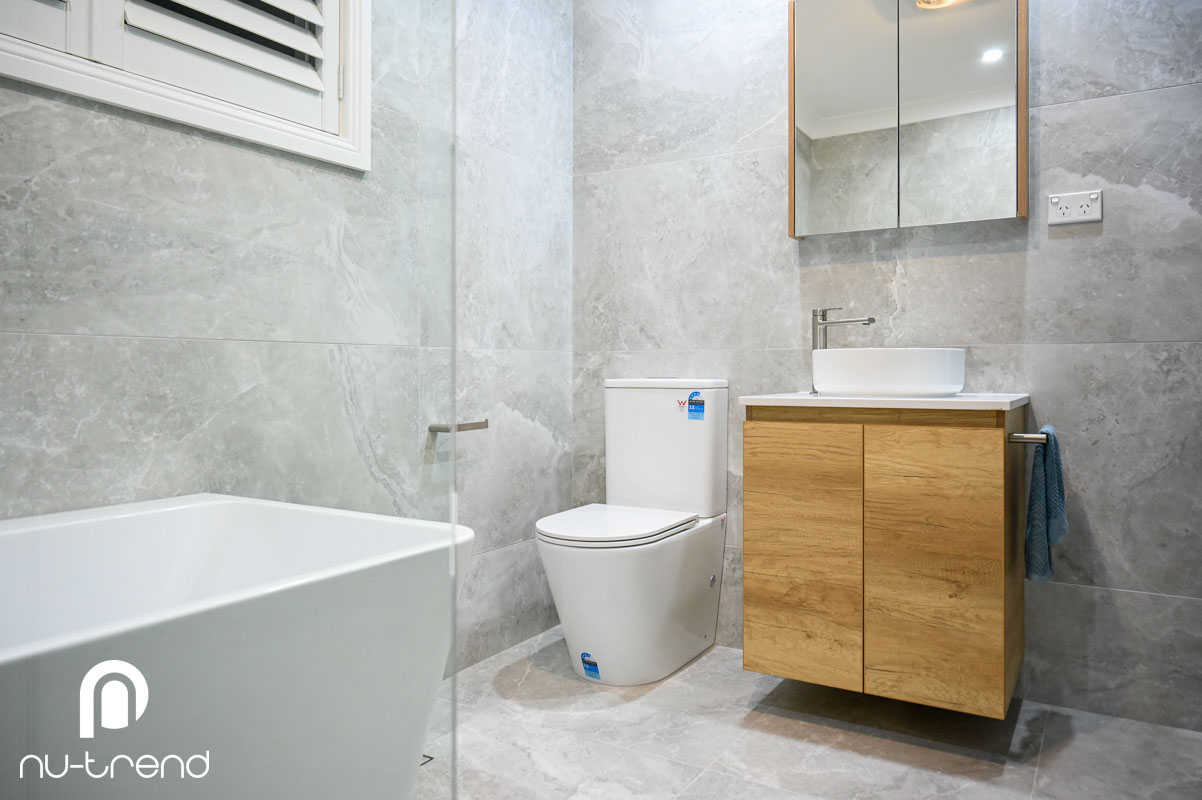
In Sydney homes the four locations that most often work are an existing laundry, the space under a staircase, a section taken from an oversized main bathroom, and a corner of a garage or rear addition that already sits close to the drainage line. Laundries in particular are the most common answer we give, because the drainage, the water supply and the floor waste are already there. We cover putting a toilet in a laundry room and the larger job of converting a laundry into a bathroom separately.
Do you need council approval to add a second toilet in NSW?
For most homes you do not need development consent from your local council to add a toilet inside an existing room, but you do need the work carried out by a licensed plumber and you do need the compliance paperwork lodged with the regulator. Approval becomes a different question when the work involves building an extension, altering the structure, or building over or close to a Sydney Water asset.
The three situations where you should expect to involve council or another approval body are these. First, where the toilet is part of an addition or a structural alteration, in which case the building work itself may require development consent or may qualify as exempt or complying development. Second, where the drainage work involves building over or adjacent to a Sydney Water sewer, which requires Sydney Water approval separately from anything council requires. Third, where the property is a strata scheme, in which case the owners corporation will generally need to approve work that affects common property, and drainage frequently is common property.
What paperwork your plumber must give you
This is where adding a toilet differs from replacing one, and it is worth understanding because the paperwork is your protection if anything goes wrong later or when you come to sell.
A straightforward bathroom renovation where the fixtures stay in the same positions is treated as minor work and does not require a Notice of Work to be lodged. Adding a new toilet moves or creates a fixture, so that exemption no longer applies and the plumber must lodge a Notice of Work before starting. On completion the plumber must issue a Certificate of Compliance and give a copy to you as the property owner, and must also lodge a Sewer Service Diagram showing where the drainage now runs. In Sydney Water’s area of operations these are lodged with Building Commission NSW through the MyInspections Gateway.
| Document | When | Who provides it |
|---|---|---|
| DocumentNotice of Work | WhenBefore the work starts | Who provides itYour licensed plumber lodges it |
| DocumentCertificate of Compliance | WhenOn completion, or before the final inspection | Who provides itYour plumber lodges it and gives you a copy |
| DocumentSewer Service Diagram | WhenOn completion of the drainage work | Who provides itYour plumber lodges it |
If a plumber cannot tell you which of these they will lodge, that is the point to stop and ask why. Nu-Trend lodges all three as part of the job under NSW contractor licence 217859C.
If a quote for adding a toilet does not mention any of these, that is worth asking about. A Sewer Service Diagram in particular becomes important years later, because it is the record of where the drainage actually runs under your property, and the next person who has to work on it will rely on it.
When a macerator toilet makes sense and when it does not
Where gravity drainage genuinely cannot reach a location, a macerator toilet grinds waste and pumps it through a small bore pipe to the drainage line. That allows a toilet to be installed in places that would otherwise be impossible, such as a basement or a room a long way from the stack with no available fall.
The trade offs are real and should be understood before choosing this route. A macerator has a motor and a cutting mechanism, so it is a maintenance item rather than a fitting that lasts indefinitely, it requires a power supply beside the toilet, it is audible when it runs, and it is intolerant of anything being flushed that should not be. Where gravity drainage can be achieved we will always recommend it, and we suggest a macerator only when the alternative is not building the toilet at all.
We can install a macerator toilet but we don’t typically install a lot of them because we aim to get gravity fall installations given they are the better option that doesn’t need maintenance vs using a machine that can block up. We buy our macerators from trusted suppliers like Reece who sell brands such as Saniflow, Vada & Ciclon. There are cheaper brands available but from experience these may not be as reliable.
How long the work takes
Where the new toilet sits close to existing drainage and no building work is required, the plumbing is generally completed in 1 day. Where the floor has to be opened, or a room has to be formed, waterproofed and tiled, the timeline extends up to 18 days days because of the drying periods that the waterproofing membrane and the screed require. Those drying times are set by the product manufacturer and by AS 3740, and compressing them is the most common cause of the waterproofing failures we are later called in to repair.
Screed, water proofing and tiling can take anywhere between 12-18 days. A lot of this depends on the existing room material, the brands and waterproofing agents we are using depending on the room. The weather pays a large role in the outcome e.g. if it’s hot it will cure faster. We won’t rush this process no matter what because even when it feels dry, it hasn’t cured internally which is what causes movement and expansion which then leads to failure and tile cracking.
Adding a bidet at the same time
If you are opening the floor and running new drainage anyway, adding a bidet at the same time costs considerably less than adding one later, because the drainage, the water supply and the making good are shared across both fixtures. Bidets have their own considerations around water supply, backflow prevention and the space required beside the toilet, which we cover in our guide to bidet installation in Sydney.
Common questions about bathroom subfloor repairs
Can I add a toilet to my house without a plumber?
No. In New South Wales, plumbing and drainage work must be carried out by a person who holds the appropriate licence, and the work must be certified. Beyond the legal position, an incorrectly vented or incorrectly graded connection causes odour, blockages and eventually water damage, and the cost of correcting it exceeds the cost of doing it properly the first time.
How close does the new toilet need to be to the existing plumbing?
There is no fixed maximum distance. What matters is whether a continuous fall at the required grade can be achieved along the whole run, and whether the drain can be vented properly. A toilet three metres from the stack in a house with a generous subfloor is easier than one two metres away on a slab with no depth to work with.
Does adding a second toilet add value to a home?
A second toilet is consistently one of the changes buyers and tenants look for in a home with one bathroom, particularly where more than two people live there. Research indicates that it can add value to your home
Can a toilet be added to an apartment?
Often yes, although the constraints are different. Drainage in an apartment usually connects to a common stack, the floor is generally a concrete slab with limited depth for new drainage, and the owners corporation will need to approve work affecting common property. We do apartment bathroom renovations across Sydney and we assess these three factors before quoting.
What is the cheapest way to add a toilet?
Placing the new toilet as close as possible to existing drainage, ideally against a wall that already carries it, and choosing a room that already has a floor waste and a water supply. A laundry meets all three conditions more often than any other room in a Sydney home, which is why it is where most second toilets end up.
Find out whether it can be done in your home
Whether a second toilet is possible in your house is a question about drainage rather than a question about design, and it can usually be answered in a single site visit. We will look at where your drainage runs, tell you honestly which locations will work and which will not, and give you a fixed written price. Call Rick on 0401 165 779 or request a site visit and we will arrange a time.
Get the floor looked at before it gets more expensive
If your floor is moving, your tiles are cracking or your bathroom smells musty, the most useful next step is a bathroom inspection rather than a quote, because until someone has looked under the floor any price is a guess.
We will come out, assess what has actually happened and give you a written scope with a fixed price.
Call Rick on 0401 165 779 or request a site visit and we will arrange a time that suits, including outside normal working hours.