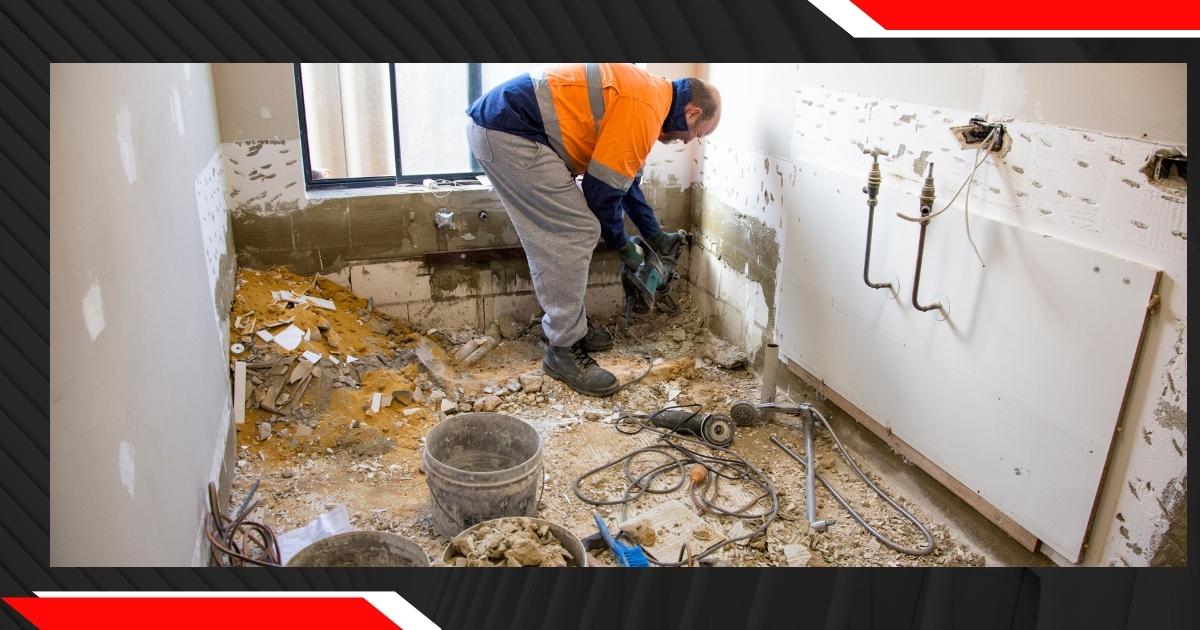
Failed bathroom waterproofing: how to spot it and what it costs to fix
Waterproofing is the layer between your shower and the structure of your house, and it is the one part of a bathroom you cannot inspect once the tiles are on. When it fails, the damage happens out of sight for months or years before anything appears on the surface, which is why the first visible sign is usually well past the point where a small repair would have been enough.
Failed waterproofing is consistently one of the most common building defects found in Australian homes, and it is the single defect we are asked to inspect more than any other. This page covers how to recognise it, what causes it, what a repair costs in Sydney, and what your options are if the bathroom was renovated recently.
Seven signs your waterproofing has failed
Any one of these is worth investigating. Two or more together generally means water has been getting through for some time.
1. Paint bubbling or peeling on the other side of a shower wall
The most reliable early sign, and the one that brought us to the Blakehurst job below. Water passes through the wall and appears in the adjoining room or hallway as bubbling paint, lifting render or a stain that keeps coming back after it is painted over.
2. A musty smell that does not clear
The smell of mould persisting in a dry, ventilated room means moisture is sitting somewhere it cannot evaporate from, which usually means inside a wall cavity or under the floor.
3. Grout or silicone that keeps failing in the same place
Repeated failure in one spot indicates movement, and movement in a tiled floor generally means the substrate beneath it is deteriorating.
4. Tiles cracking, lifting or sounding hollow
Tap along a tiled floor with a knuckle. A hollow sound means the tile has lost its bond to the bed beneath it, which is frequently a sign that the bed itself has taken water.
5. Water pooling on the floor after a shower
Water that sits rather than draining means the floor does not fall correctly to the waste. Sometimes that is how it was built. Sometimes it is because the floor has moved, and movement means something underneath has changed.
6. Damp or discoloured skirting, carpet or floorboards outside the bathroom
Water leaving the bathroom at floor level and appearing in the next room is unambiguous. By the time it is visible the subfloor has usually been wet for a long time.
7. A toilet, vanity or bath that has become loose
Fixings need something solid to grip. When they work loose, the material around them has often deteriorated. We cover why bathrooms get water leaks in Sydney separately.
Why waterproofing fails
It fails for a small number of reasons and almost all of them are workmanship rather than product.
- The membrane was applied over a substrate that was not suitable, such as particleboard flooring in a wet area, which is why floor preparation matters as much as the membrane itself.
- It was tiled over before it had cured. Membranes have a specified drying time and rushing it is the most common single cause of failure.
- It was not taken high enough up the shower walls, or not carried into the vertical angles, so water tracks around the edge of it.
- The junctions were not detailed properly. Where the floor meets the wall, where a hob meets the floor, and around the floor waste are where failures start.
- The floor moved. A flexible membrane tolerates some movement, but a substrate that flexes more than the system allows will eventually split it.
- It was done by someone unlicensed, or it was not certified, which usually means nobody checked any of the above.
What it costs to put right
| Situation | What is involved | Indicative cost |
|---|---|---|
| SituationShower area only, damage contained | What is involvedStrip the shower floor and walls, replace the substrate where needed, re-waterproof and re-tile the shower | Indicative cost$10,000 to $14,000 |
| SituationWhole floor, structure sound | What is involvedStrip the floor, new screed and membrane across the room, re-tile the floor | Indicative cost$8,000 to $13,000 |
| SituationWhole room, subfloor damaged | What is involvedFull strip out, subfloor repair or replacement, then re-waterproof and re-tile the room | Indicative cost$38,000 to $48,000 |
| SituationFull renovation because the room needed it anyway | What is involvedComplete bathroom renovation with correct waterproofing throughout, existing layout retained | Indicative cost$35,000 to $40,000 |
Figures are based on repairs Nu-Trend has completed across Sydney and are confirmed with a fixed written quote once the extent of the damage is known. A shower repair can cost more than a whole floor because the shower walls have to come off as well.
The gap between the second and third rows is the floor structure. Once water has reached the bearers, joists or slab, the job stops being a waterproofing repair and becomes a structural one, and what a subfloor repair costs sets out that range on its own. It is also why the fourth row can be cheaper than the third: a room that is being fully renovated with a sound floor costs less than a room where the floor has to be rebuilt first.
Can failed waterproofing be repaired without redoing the bathroom?
This is the question everyone asks and the honest answer is usually no, at least not properly. The membrane sits underneath the screed, which sits underneath the tiles. Reaching it means removing everything above it, and once the tiles are off, matching them is rarely possible in a bathroom more than a few years old.
There are products marketed as surface applied waterproofing that can be rolled over existing tiles. In a shower with a genuinely minor problem and a tolerance for the appearance, they can extend the life of a room. What they do not do is repair a membrane that has failed underneath, and they do nothing at all if the substrate below has already taken water.
The realistic choice in most cases is between repairing the shower area and re-tiling that section, which leaves a visible difference, or renovating the room. Which of those makes sense depends mostly on how old the bathroom is and how contained the damage turns out to be.
A brand new bathroom that had already failed
The photographs on this page come from a home in Blakehurst where the owners had recently paid $15,000 for a bathroom renovation. Within a short time they noticed the paint bubbling on the living room side of the shower wall. The wall had begun to swell, the paint was peeling and the render was coming away.
The waterproofing had failed, and it had not failed on its own. Within a few minutes in the room it was clear that the standard of the whole job was the underlying problem. Among the defects we found:
- A pre-fabricated shower screen that did not fit the space, with a ramp built up in the floor tiles to accommodate it, creating both a trip hazard and a place for water to sit.
- Floor tiles split rather than cut around the floor waste, leaving an uneven finish and gaps where water collected.
- Grout line gaps that varied noticeably between the floor and the walls.
- Hairline cracks in every tile.
- Uneven grout and silicone joints throughout.
- Missing cover plates at the toilet.
- Poor patching around the door.
- A floor gradient that did not fall correctly to the waste.
- A light switch that did not work and, when pressed firmly, presented a genuine electrical risk.
Individually, several of these are cosmetic. Together they describe a job done quickly by someone who was not checking their own work, and the waterproofing was the part of that job nobody could see. It is the clearest illustration we have of why cheap renovation quotes cost more, and you can see what years of the same failure does to a slab in a renovation where we repaired concrete cancer.
The owners were understandably reluctant to spend again on a bathroom they had just paid for, which is the position a bad renovation leaves people in, and in the end they chose not to go ahead with the repair. Our advice then is the same as it is now: a bathroom with failed waterproofing does not stabilise, and the cost of leaving it rises every year it is left.
What a compliant bathroom waterproofing job looks like
Waterproofing of domestic wet areas in Australia is covered by AS 3740. In a typical bathroom that means the entire floor is waterproofed, the shower walls to a defined height, the vertical angles, and any hob or step. In New South Wales the work must be carried out by a licensed waterproofer and certified, and doing it yourself can affect both a warranty and an insurance claim.
A properly built bathroom floor is stripped back to structure, inspected, rebuilt in a substrate suitable for a wet area, screeded to fall, waterproofed with the membrane taken into every junction, left to cure for the time the product specifies, and certified before a single tile is laid. Every stage is photographed. None of it can be verified afterwards, which is why the certificate matters. The photographs above show a custom measured shower screen, a floor waste cut cleanly into the tile pattern and a floor that falls to the drain, which is what the Blakehurst bathroom should have looked like.
What to do if your renovation was recent
If the bathroom was renovated in the last few years and the waterproofing has failed, you may have options beyond simply paying again.
- Find the paperwork. A Certificate of Compliance for the plumbing and a waterproofing certificate should both exist. If neither does, that is significant in itself.
- Get an independent inspection with a written report and photographs. You need evidence of what is wrong before you have any conversation with the original contractor.
- Contact the contractor in writing. Residential building work in New South Wales carries statutory warranties under the Home Building Act, which cover major defects such as waterproofing failure for six years from completion and other defects for two years.
- If that goes nowhere, NSW Fair Trading has a complaint process for residential building work.
- Only then decide whether to repair or renovate, because the decision changes if someone else may be liable for part of it.
We provide written inspection reports with photographs for exactly this purpose, and we are willing to say plainly in writing what we find.
Common questions about failed waterproofing
How do I know if my bathroom waterproofing has failed?
The most reliable early sign is bubbling or peeling paint on the far side of a shower wall. Others are a persistent musty smell, grout and silicone that keep failing in one spot, hollow sounding tiles and water pooling on the floor after a shower.
How long should bathroom waterproofing last?
A correctly installed membrane in a normally used bathroom should last the life of the renovation, which is typically fifteen to twenty years or more. Failures inside the first five years are almost always workmanship rather than wear.
Can you waterproof over existing tiles?
There are surface applied products that go over tiles and they have a place in limited circumstances. They do not repair a failed membrane underneath and they do nothing about a damaged substrate. They are a way of extending the life of a room, not a repair.
Who is responsible if a new bathroom leaks?
Residential building work in New South Wales carries statutory warranties under the Home Building Act 1989. Major defects, which include waterproofing failure, are covered for six years from completion and other defects for two years, and the warranties cannot be contracted out of. The practical requirements are that you have evidence of the defect and that you raise it with the contractor in writing. NSW Fair Trading publishes the current guidance.
Does home insurance cover failed waterproofing?
Generally not. Home insurance policies in Australia commonly cover a sudden escape of water and exclude gradual damage from deterioration or defective work, which is what failed waterproofing usually is. It is worth checking your own policy rather than assuming either way.
Get your bathroom inspected
If you suspect your waterproofing has failed, an inspection tells you what you are dealing with and gives you something in writing. We are licensed plumbers and licensed renovators, we inspect wet areas across Sydney and we provide a written report with photographs.
Call Rick on 0401 165 779 or book a bathroom inspection.