3 way bathroom layouts, designs and costs
A 3 way bathroom splits one room into three separate spaces, usually a toilet behind its own door, a bath and shower area behind another, and a vanity that can be used while the other two are occupied. It was standard in Australian homes from the nineteen sixties onward, it is still built deliberately today, and it is also one of the most common layouts people ask us to undo.
This page covers both directions. What a 3 way bathroom is and how to lay one out well if you want to create one, and what your options are if you already have one and want a normal bathroom back.
What a 3 way bathroom actually is
The idea is separation of function. A conventional bathroom puts the toilet, the shower and the basin in one room behind one door, so one person occupying it locks everyone else out. A 3 way layout gives each function its own space so that three people can be doing three different things at the same time.
The usual arrangement is a toilet in a small room of its own, a bathroom containing the bath and the shower, and a vanity area either open to a hallway or sitting between the two as a shared space. A related layout, sometimes called a 2 way or Jack and Jill bathroom, separates only the toilet from the rest, or gives one bathroom two doors so it can be reached from a bedroom and from a hallway.
It is worth being clear that this is a layout decision rather than a fixture decision. Nothing about the toilet, the shower or the vanity is different. What changes is where the walls and the doors go.
Four 3 way layouts that work
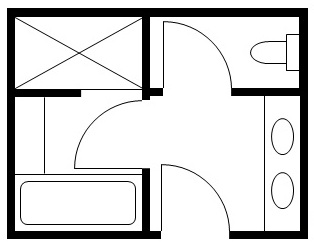
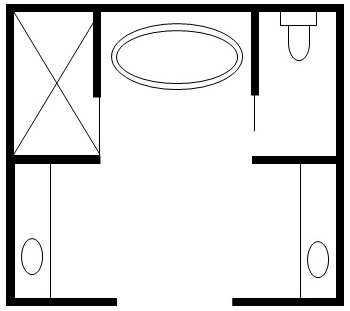
In line: three spaces
off one hallway
- Doors
- Three doors off the hall, which is efficient but produces a corridor of doors
- Room shape
- Long and narrow, about 4.4m x 1.8m or larger
- Suits
- Long narrow footprints, which is the most common shape in older homes
Vanity in the middle, toilet
and bathroom either side
- Doors
- One door into the vanity area, then a toilet door and a sliding bathroom door off it
- Room shape
- Squarer rooms, about 3.6m x 2.4m or larger
- Suits
- Households that want the vanity as the shared space
Toilet separated, bath and
shower together, vanity open
- Doors
- Two doors only, with the vanity open to the hall or the bedroom
- Room shape
- Works in a 3m x 3m room
- Suits
- Smaller total footprints where three full rooms will not fit
Jack and Jill,
two entries
- Doors
- A sliding cavity door from each bedroom, with locks that indicate occupancy
- Room shape
- Any, as long as it sits between two bedrooms
- Suits
- Homes where the bathroom sits between two bedrooms
Schematic plans only, drawn to show where the walls, doors and wet zones sit. We draw the real layout to your room's measurements before quoting.
| Layout | Suits | Where the doors go |
|---|---|---|
| LayoutIn line, three spaces off one hallway | SuitsLong narrow footprints, which is the most common shape in older homes | Where the doors goThree doors off the hall, which is efficient but produces a corridor of doors |
| LayoutVanity in the middle, toilet and bathroom either side | SuitsSquarer rooms where the vanity can be the shared space | Where the doors goOne door into the vanity area, then two internal doors off it |
| LayoutToilet separated, bath and shower together, vanity open | SuitsSmaller total footprints where three full rooms will not fit | Where the doors goTwo doors only, with the vanity open to the hall or the bedroom |
| LayoutJack and Jill, two entries | SuitsHomes where the bathroom sits between two bedrooms | Where the doors goA door from each bedroom, with locks that indicate occupancy |
Will one fit? Room sizes and the 3 by 3 metre question
The most common question we get about 3 way layouts is whether the room is big enough, and it is usually asked about a 3 metre by 3 metre space because that is a very common bathroom footprint in Australian homes.
Nine square metres is enough for a genuine 3 way layout, though it is close to the practical minimum and the arrangement matters more than the area. As a working guide, a separate toilet needs about 0.9 by 1.5 metres, a bathroom with a bath and a shower needs about 2.4 by 2.4, and a vanity area needs about 1 by 1.5. Those add up to more than nine square metres if you build them as three separate boxes, which is why the layouts that work in a 3 by 3 room share space rather than dividing it evenly.
| Total room | What fits comfortably |
|---|---|
| Total roomUnder about 6 square metres | What fits comfortablyNot a 3 way layout. Separating the toilet alone is usually the most that works |
| Total roomAbout 6 to 9 square metres | What fits comfortablyToilet separated, bath and shower together, vanity open to the hall |
| Total roomAbout 9 to 12 square metres | What fits comfortablyA full 3 way layout with three defined spaces |
| Total roomOver about 12 square metres | What fits comfortablyA full 3 way layout with a double vanity, or two complete bathrooms instead |
What a 3 way bathroom costs to build in Sydney
Converting an existing bathroom into a 3 way layout in Sydney usually falls between $50,000 and $80,000. The bottom of that range is a room where the existing plumbing positions can be reused and the new internal walls are non structural. Moving fixtures and altering structural walls each add to it.
| Scope | What is involved | Indicative cost |
|---|---|---|
| ScopeExisting plumbing positions retained | What is involvedNew internal walls and doors, new fixtures, full wet area build over the existing footprint | Indicative cost$50,000 to $80,000 |
| ScopeFixtures relocated | What is involvedDrainage and water moved to suit the new layout, which on a slab means saw cutting | Indicative costAdds $8,000 to $16,000 |
| ScopeStructural work or the room enlarged | What is involvedEngineering, a load bearing wall altered or removed, space taken from an adjoining room | Indicative costAdds $5,000 to $15,000 |
Figures include labour and a mid range specification and are confirmed with a fixed written quote after a site visit.
The largest single variable is whether the fixtures stay where they are. Building new internal walls is comparatively cheap. Moving a toilet is not, because it needs the largest waste at the steepest fall, and on a concrete slab that means cutting a channel and making it good.
Who a 3 way bathroom suits, and who it does not
The case for a 3 way layout is strongest in one specific situation: a household of four or more sharing a single bathroom, in a home where adding a second bathroom is not possible or not affordable. In that household the layout genuinely changes daily life, because the morning bottleneck is three people needing three different things at once.
It suits less well where the household is small, where the home already has a second bathroom, or where the room is under about six square metres. In those cases the separation costs you space and gains you very little, and one good bathroom is worth more than three compromised parts of one.
It is also worth thinking about who lives there in five years rather than only today. A layout built around four teenagers is a different proposition once they have moved out.
The honest downsides
We build these, and we also convert a great many of them back, so it is worth setting out plainly what people dislike about them.
- Each space is smaller. Three rooms in the footprint of one means the toilet is a cupboard, the vanity area is tight and the bathroom is dominated by whatever is in it.
- Doors consume floor area. Three or four doors, each needing space to swing, take up room that none of the three spaces can spare.
- It costs more than a single bathroom of the same total size, because there is more wall, more tiling, more doors and more labour.
- Only one person can shower. The multi user logic solves the basin and the toilet, and the thing people actually queue for is the shower.
- Ventilation gets harder. Three small spaces with one window between them, and often an exhaust fan in only one of them.
- It reads as dated to some buyers, which is worth understanding before spending money on creating one.
None of these is a reason not to build one where the household needs it. They are the reasons that the same layout, twenty years later, is the one we are asked to undo.
Already have one and want it changed? Four ways to reconfigure
If you have inherited a 3 way bathroom and it is not working for your household, you have more options than simply renovating the three spaces as they are. Redrawing the internal walls is usually possible, because in most homes of this era they are not structural.
1. Combine all three into one generous bathroom
The simplest change and often the most satisfying. Removing the internal walls produces a room large enough for a walk in shower, a bath, a double vanity and real storage. It suits homes that already have a second toilet elsewhere, or households that would rather have one excellent bathroom than three compromised parts of one.
2. Split into a main bathroom and a separate second bathroom
Redraw the dividing line rather than removing it, so that instead of three fragments you have two complete rooms, each with a shower, a toilet and a vanity. This is usually the highest value outcome, because it takes a three bedroom, one bathroom home to three bedrooms and two bathrooms, which is a different property.
3. Main bathroom plus a combined second bathroom and laundry
Where the laundry sits adjacent or nearby, folding it into the reconfiguration produces a main bathroom and a second room that does two jobs, and our combined bathroom and laundry floor plans page covers how to lay that out. It frees up whatever the laundry occupied and it is often the most efficient use of the available footprint.
4. Ensuite plus a separate main bathroom
Where the 3 way bathroom backs onto a main bedroom, part of the footprint can become an ensuite entered from the bedroom, with the remainder becoming a complete main bathroom off the hallway. This is the most disruptive of the four because it involves forming a new doorway through a bedroom wall, and it changes how the house lives more than any of the others. Our ensuite bathroom renovations page covers the finished room, and converting a bedroom into a bathroom or ensuite is the alternative where a spare room is available.
What a conversion costs
| Option | What is involved | Indicative cost |
|---|---|---|
| OptionRenovate within the existing 3 way footprint | What is involvedNew fixtures, tiling, waterproofing and fit off, existing walls and plumbing positions retained | Indicative cost$50,000 to $80,000 |
| OptionCombine into one bathroom | What is involvedInternal non structural walls removed, drainage reworked, full wet area build | Indicative cost$60,000 to $80,000 |
| OptionSplit into two complete bathrooms | What is involvedWalls repositioned, a second set of drainage and water, two full wet area builds | Indicative cost$60,000 to $80,000 |
| OptionStructural change or a new doorway through a bedroom wall | What is involvedEngineering, structural work, new opening, plus the above | Indicative cost$80,000 to $100,000 |
Figures include labour and a mid range specification across the whole footprint and are confirmed with a fixed written quote after a site visit.
The largest variable in every case is drainage. Splitting into two bathrooms means a second shower waste, a second basin waste and usually a second toilet, all of which have to reach the existing sewer connection at the correct fall. On a suspended timber floor with subfloor access that is straightforward. On a concrete slab it means saw cutting. Our page on adding a toilet to your existing plumbing covers what decides whether a second toilet can reach the drainage, and bathroom renovation costs in Sydney sets out what a complete room comes to.
Build one or convert one? How to decide
Both directions are legitimate and the right answer depends on the household rather than on fashion.
| Build a 3 way layout if | Convert away from one if |
|---|---|
| Build a 3 way layout ifFour or more people share one bathroom | Convert away from one ifTwo or fewer people use it, or the children have moved out |
| Build a 3 way layout ifA second bathroom is not possible or not affordable | Convert away from one ifThere is enough footprint to make two complete bathrooms |
| Build a 3 way layout ifThe room is 9 square metres or more | Convert away from one ifThe room is under about 9 square metres and everything feels cramped |
| Build a 3 way layout ifThe morning queue is for the basin and the toilet | Convert away from one ifThe morning queue is for the shower, which separation does not solve |
| Build a 3 way layout ifYou are staying in the home for a long time | Convert away from one ifYou may sell within a few years and want a conventional layout |
Can the walls actually move?
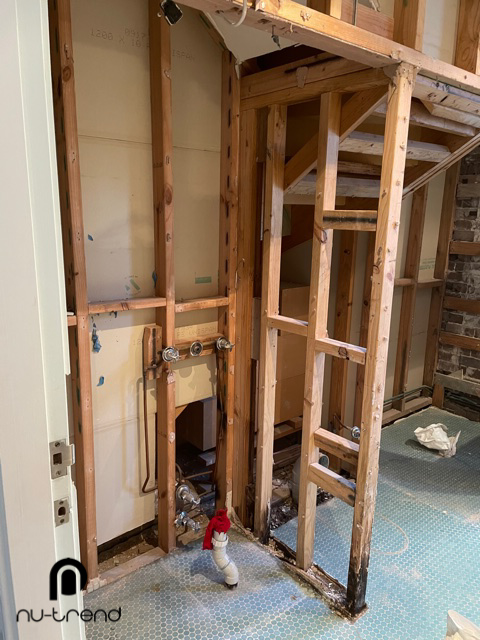
In most homes of this era the walls dividing a 3 way bathroom are non structural stud walls, which means they can be removed or repositioned without engineering. That is the usual answer and it is why these reconfigurations are more achievable than people expect.
Where a wall is load bearing it can still be removed with a beam and an engineer, which adds cost but is rarely a reason to abandon the plan. What matters more is what is inside the wall, because a dividing wall in a wet area often carries drainage, water supply and vent pipes, and relocating those is a bigger job than removing the plasterboard.
In an apartment or unit the calculation is different again, because drainage generally connects to a common stack in a fixed position and the owners corporation will need to approve work affecting common property. Our apartment bathroom renovations page covers what changes in a strata building.
What this does to the value of the house
Going from one divided bathroom to two complete bathrooms changes how a home is described and searched for, because bedroom and bathroom counts are the primary filters buyers use. A three bedroom, two bathroom home reaches a different set of buyers from a three bedroom, one bathroom home, and an agent who sells in your street will be able to tell you what that is worth locally.
In the other direction, creating a 3 way layout does not change the bathroom count, so it is a lifestyle improvement rather than a valuation one. That is not an argument against doing it. It is an argument for doing it because your household needs it now, rather than as an investment.
Common questions about 3 way bathrooms
What is a 3 way bathroom?
A bathroom split into three separate spaces, typically a toilet behind its own door, a bath and shower area, and a vanity, so that three people can use different parts at the same time. A 2 way bathroom separates only the toilet, and a Jack and Jill bathroom is one room with two doors serving two bedrooms.
Will a 3 way bathroom fit in a 3 by 3 metre room?
Yes, though nine square metres is close to the practical minimum and the layout has to share space rather than divide it into three equal boxes. Below about six square metres, separating the toilet alone is usually as far as it is worth going.
How much does a 3 way bathroom renovation cost in Sydney?
Usually between $50,000 and $80,000. Moving fixtures adds $8,000 to $16,000 and structural work adds $5,000 to $15,000 on top of that, and we give a fixed written price after seeing the room.
Can you turn a 3 way bathroom into two bathrooms?
Often yes, and it is the highest value version of this project. It depends on the total footprint and on whether a second set of drainage can reach the sewer connection at the correct fall. Both can be established in one visit, and the work usually falls between $60,000 and $80,000.
Do you need council approval?
Not usually for work inside the existing footprint with non structural walls. It becomes relevant where a load bearing wall is altered, where the property is heritage listed, or in a strata scheme where the owners corporation must approve work affecting common property. Licensed plumbing and certified waterproofing are always required either way.
Can the toilet stay where it is to save money?
Often, and it is a sensible saving where the existing position suits the new layout. The toilet is the most expensive fixture to move because it needs the largest waste at the steepest fall, so it is worth deciding this before the layout is fixed rather than afterwards.
How long does the work take?
Five to eight weeks for a renovation within the existing footprint, and seven to ten weeks where walls move or a second bathroom is created. Waterproofing and screed drying account for a meaningful part of that and cannot be shortened.
Get a layout and a fixed price
With a 3 way bathroom the useful first step is a layout rather than a quote, because the options are genuinely different and the right one depends on your household as much as on the room. We will measure, tell you which walls are structural and what is inside them, sketch the realistic options in both directions and give you a fixed written price against the one you choose.
Call Rick on 0401 165 779 or request a site visit.