What it costs to replace a toilet in Sydney
Replacing a toilet in Sydney costs around $400 to $600 in labour for a straightforward like for like swap, plus the cost of the new suite. Most people spend between $700 and $1,500 all in. The two things that push it higher are a change of trap type, which means the waste connection has to move, and a change of position, which on a concrete slab means saw cutting the floor.
Nu-Trend is a licensed Sydney plumber and bathroom renovator, so the same company can replace the suite, move the waste if it has to move, and repair the floor and tiling afterwards.
The cost, broken down
| Component | Typical range | Notes |
|---|---|---|
| ComponentLabour, like for like | Typical range$400 to $600 | NotesRemove and dispose of the old suite, install and connect the new one, test |
| ComponentThe toilet suite | Typical range$250 to $1,500 | NotesA basic close coupled suite to a wall hung unit with an in wall cistern |
| ComponentTrap or position change | Typical range$600 to $2,000 | NotesWhere the waste connection has to move, on a timber floor or a slab |
| ComponentMaking good | Typical range$1,000 to $2,000 | NotesTiling repair where the new pan does not cover the old footprint, depending on whether preparation, sheeting, concrete, waterproofing and tiling are needed |
Labour figures exclude GST and are confirmed with a fixed written quote once we have seen a photograph of the toilet and the set out measurement.
A wall hung pan with a concealed cistern is a different job again, because the cistern sits inside a framed wall that has to be built, and the wall then has to be lined and tiled. It is a considerably better looking result in a small bathroom and it is not a like for like replacement.
Check your trap before you buy anything
This is the single most useful thing on this page and it is the reason a replacement goes wrong. Toilets connect to the drainage in one of two ways, and buying the wrong one is the most common mistake people make.
| Trap type | Where the waste goes | How to tell |
|---|---|---|
| Trap typeS trap | Where the waste goesDown through the floor | How to tellThe waste pipe disappears into the floor behind or beneath the pan |
| Trap typeP trap | Where the waste goesBack through the wall | How to tellThe waste pipe runs horizontally into the wall behind the pan |
With an S trap there is a second measurement that matters, called the set out, which is the distance from the finished wall to the centre of the waste. Suites are sold for specific set outs, and a pan bought for a 140mm set out will not fit a 165mm one without an adaptor or without moving the waste.
Both trap types are equally common in Sydney homes and neither is right or wrong. What matters is that the new suite matches how the existing plumbing was installed, or, where we are installing new plumbing, that the set up and style of toilet you choose matches the plumbing we put in. Before you buy, measure the set out and note whether the waste goes into the floor or the wall. If you send us a photograph of the toilet from the side and that measurement, we can tell you what will fit.
The four types of toilet, and what each needs
| Type | What it is | What it needs |
|---|---|---|
| TypeClose coupled | What it isCistern sits directly on the pan, the most common type in Australian homes | What it needsA straight swap in most cases, provided the trap and set out match |
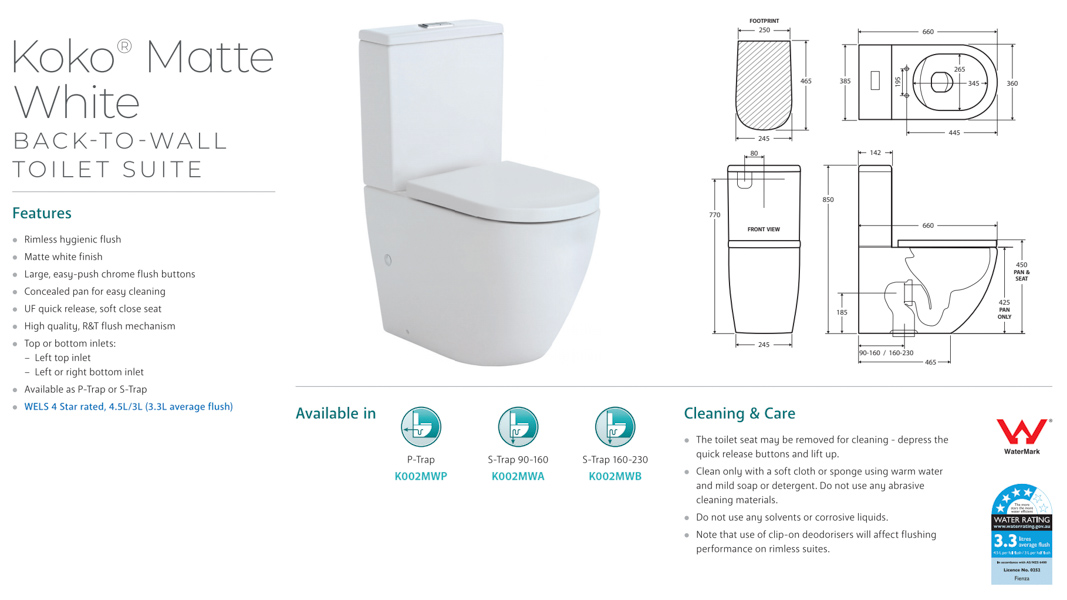
| TypeBack to wall | What it isPan sits flush against the wall, cistern concealed or semi concealed | What it needsThe wall behind must be able to take the fixings and be flat enough |
| TypeWall faced | What it isPan sits against the wall with the cistern above or behind, no gap to clean behind | What it needsSimilar to back to wall, with the same wall requirements |
| TypeWall hung | What it isPan fixed to the wall, off the floor, cistern hidden inside the wall | What it needsA framed wall built to carry the load, then lined and tiled. Not a like for like swap |
In a small bathroom a wall hung pan makes a visible difference, because the floor runs underneath it and the room reads as larger. It costs more and it is worth considering at the point a bathroom is being renovated rather than as a standalone change.
When a replacement becomes a bigger job
Four things turn a short job into a longer one, and all four are foreseeable if someone looks first.
- The trap type or set out does not match, so the waste connection has to move.
- The new pan has a smaller footprint than the old one, exposing untiled or damaged floor.
- The existing waste connection or the flange is deteriorated, which is common in older homes and is not visible until the old pan is lifted.
- The floor beneath the toilet has been affected by a slow leak at the pan connector, which is one of the most common causes of bathroom subfloor damage.
That last one is worth taking seriously. A toilet that rocks slightly, or whose fixings have worked loose, is frequently the first sign that the floor underneath has deteriorated. If yours moves, mention it when you book, because what a subfloor repair costs is a very different conversation from a toilet swap.
Moving a toilet to a different position
Moving a toilet is the most involved of the common bathroom fixture changes, because the waste is the largest pipe in the room and it needs the most fall. It is entirely achievable and it is frequently what unlocks a better layout.
On a suspended timber floor, new drainage can usually be run underneath, which is the more straightforward case. On a concrete slab, the slab is saw cut to create a channel, the new pipe laid at the required grade, the connection made, and the slab repaired before the floor is screeded and finished.
Because moving a toilet creates a new fixture position, the work requires a Notice of Work lodged before starting, a Certificate of Compliance issued on completion, and a Sewer Service Diagram showing the new drainage. A like for like replacement in the same position does not. If you are considering adding a second toilet to your home rather than replacing the one you have, that is covered separately.
Replacing just the cistern
If the pan is sound and the cistern is cracked, leaking or has failed internally, replacing the cistern alone is often possible and costs less than a full suite. Whether it is depends on whether a matching cistern is still available, which for suites more than about ten years old frequently it is not.
A running cistern is worth dealing with promptly rather than living with. A continuously running toilet wastes a substantial volume of water over a year, and the repair is usually an inexpensive internal part rather than a new cistern at all.
What is involved on the day
- Isolate the water supply and drain the cistern.
- Disconnect the water supply and remove the old suite, which can be slow where it was bedded in cement or heavy silicone.
- Clean the area of any old cement, glue or silicone and prepare the connection.
- Inspect the waste connection, the flange and the floor around it, which is the moment any hidden problem appears.
- Assemble the new suite, which usually arrives as a separate pan and cistern, and check it for fit and level before anything is fixed.
- Set the pan, connect the waste, fit and connect the cistern.
- Connect the water supply, then test and commission under pressure.
- Seal the base, clean, and remove the old suite from the property.
A like for like replacement usually takes between two and six hours, depending on how easily the old toilet comes out, how much cleaning and preparation the area needs, and the assembly and testing of the new suite. Where the waste has to move or the floor needs repair, it becomes a longer job and may need a second visit.
Common questions about toilet replacement
How much does it cost to replace a toilet in Sydney?
Around $400 to $600 in labour for a like for like replacement, plus the suite. Most people spend between $700 and $1,500 all in. Moving the waste adds $600 to $2,000 and any tiling repair adds $1,000 to $2,000 on top.
Do I need a plumber to replace a toilet?
Yes. Connecting a fixture to the sanitary drainage is plumbing work and in New South Wales it must be carried out by a licensed person. Beyond the legal requirement, a pan connector that is not sealed correctly leaks slowly into the floor and the damage is not noticed for months.
What is the difference between an S trap and a P trap?
An S trap discharges down through the floor. A P trap discharges back through the wall. Which one you have is fixed by your drainage, and buying the wrong type means either moving the waste connection or returning the suite.
Can a toilet be moved on a concrete slab?
Yes. The slab is saw cut to create a channel for the new drainage line, the pipe is laid at the required grade, the connection made and the slab repaired before the floor is finished. It is normal work and it is priced according to the distance and the floor construction.
Is it worth replacing a toilet on its own or waiting for a renovation?
If the bathroom is due to be renovated within a year or two, wait, because the toilet will come out again and the work is duplicated. If the renovation is years away, or the toilet is leaking, cracked or continuously running, replace it now. Our bathroom renovations page covers the full room, and bidet installation in Sydney is the addition people most often make at the same time.
Get a price for your toilet replacement
Send us a photograph of your toilet from the side, and the distance from the wall to the centre of the waste, and we can usually give you a price the same day.
Call Rick on 0401 165 779 or request a quote.